
Most parents assume a nanny is just a babysitter with a fancier title. That assumption leads to mismatched expectations, frustrated caregivers, and childcare arrangements that fall apart within months. A full-time nanny is something meaningfully different. This guide breaks down the full-time nanny definition, what the role actually involves day to day, what it costs, and how to hire someone you can genuinely trust with your child. Whether you are a first-time parent or a busy professional trying to figure out your options, this is the clarity you need before making one of the most personal decisions of your family’s life.
| Point | Details |
|---|---|
| Full-time nanny definition | A full-time nanny works 40 or more hours per week with consistent, ongoing childcare responsibilities. |
| Distinct from babysitters | Full-time nannies provide developmental support and long-term care, not just supervision. |
| Real financial commitment | Salaries typically range from $60,000 to $80,000 annually, plus payroll taxes and benefits. |
| Agencies reduce hiring risk | Professional placement agencies handle vetting, contracts, and background checks to save parents time. |
| Treat nannies as professionals | Offering benefits like paid time off and guaranteed hours directly improves retention and care quality. |
A full-time nanny is a professional caregiver employed by a family to provide consistent, ongoing childcare, typically working 40 to 50 hours per week on a regular schedule. This is not a drop-in arrangement. Full-time nannies work under employment agreements, show up five days a week, and become a stable fixture in a child’s daily life.
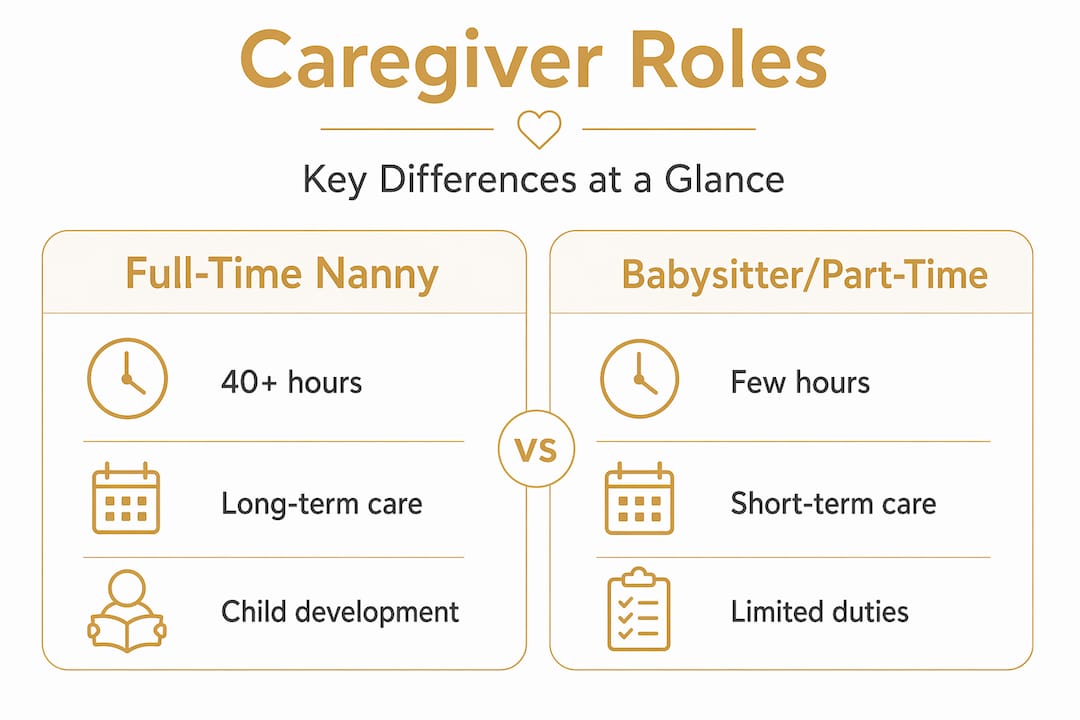
The full-time nanny definition sets this role apart from both part-time nannies and babysitters in three concrete ways.
Full-time nanny vs part-time nanny vs babysitter:
| Role | Typical Hours | Contract Type | Developmental Role |
|---|---|---|---|
| Full-time nanny | 40 to 50+ hours/week | Ongoing employment | Yes, active and consistent |
| Part-time nanny | 15 to 30 hours/week | Ongoing but limited | Moderate |
| Babysitter | As needed | Casual, no contract | Minimal |
A babysitter watches your child for a few hours on a Friday night. A part-time nanny might cover school pickups and afternoons. A full-time nanny, by contrast, is present for the majority of your child’s waking hours. That presence matters enormously. Full-time nannies provide consistent, nurturing care including developmental and educational activities that simply are not part of a babysitter’s role. They know your child’s moods, routines, fears, and milestones in a way that no one else outside your immediate family does.
The scope of full-time nanny responsibilities is wider than most parents expect when they first start researching childcare. Yes, supervision is part of it. But the role goes well beyond keeping a child safe while parents are at work.
Typical full-time nanny duties include:
One thing that surprises many first-time parents: a skilled nanny brings genuine professional judgment to the role. They are not waiting for you to tell them what to do every hour. They adapt activities to your child’s developmental stage, notice when something seems off, and handle unexpected situations with calm. That autonomy is a feature, not a risk. It is what separates a professional nanny from someone just filling time.
Pro Tip: Before your nanny starts, create a written daily schedule together. This gives your nanny a framework to work within while leaving room for their professional judgment. It also reduces the adjustment period for your child.

For busy parents, the practical benefits of a full-time nanny are significant. But the developmental benefits for children are what often seal the decision for families who go this route.
Consistency your child can count on. Your child sees the same face every morning. That predictability builds emotional security, especially in children under five whose attachment needs are high.
Care tailored to your child specifically. Unlike daycare, where one teacher manages eight to twelve children, a full-time nanny focuses entirely on your child or your children. Activities, meals, nap schedules, and learning goals are built around your family’s needs.
Flexibility that daycare cannot match. Your child gets sick. Your meeting runs late. Your flight is delayed. A full-time nanny adapts to your life in ways that a daycare center structurally cannot.
Stronger developmental outcomes. Children in consistent, one-on-one care settings tend to develop language skills and emotional regulation more quickly during early years. The relationship itself is part of the benefit.
Reduced daily stress for parents. Knowing your child is in capable hands with someone who knows them well removes a layer of mental load from your workday. That matters more than most parents realize until they experience it.
Families who treat nannies as professionals with real benefits and job security consistently report higher quality care and longer-lasting relationships. The investment in the relationship pays off directly in the care your child receives.
This is the section most parents skip until they are already in the hiring process. Do not skip it. Understanding the financial and legal reality of employing a nanny before you start saves you from expensive surprises.
Salary ranges in 2026:
| Experience Level | Hourly Rate | Estimated Annual Cost |
|---|---|---|
| Entry-level nanny | $17 to $22/hour | $35,000 to $46,000 |
| Experienced nanny | $22 to $28/hour | $46,000 to $58,000 |
| Highly experienced/specialized | $28 to $35/hour | $58,000 to $73,000 |
Typical full-time nanny salaries range from roughly $60,000 to $80,000 per year in many metropolitan areas, depending on experience and location. That number is before you factor in employer costs.
When you hire a nanny, you become a household employer. That means you are responsible for FICA taxes, unemployment taxes, and filing Schedule H and a W-2 at tax time. Many parents are caught off guard by this. Budget an additional 10 to 12 percent on top of your nanny’s salary to cover your employer tax obligations.
Federal law also requires overtime pay at 1.5 times the hourly rate for any hours worked beyond 40 per week. If your nanny regularly works 45 hours, those extra five hours cost more than the base rate.
On the benefits side, paid time off of 5 to 15 days per year and paid holidays are industry standards in most markets. Offering these is not just generous. It directly affects your ability to attract and keep a high-quality caregiver.
Pro Tip: Use a nanny payroll service to handle tax calculations, paycheck processing, and year-end filings. The cost is modest compared to the risk of getting payroll wrong as a first-time household employer.
Finding a full-time nanny on your own is possible. It is also time-consuming, stressful, and carries real risk if you do not know what to screen for. Here is what the process actually involves.
Key steps in the hiring process:
Using a nanny agency typically costs around 20 percent of the nanny’s annual salary as a placement fee. For a nanny earning $72,800 per year, that is roughly $14,560. For many families, that cost is worth it given the time saved and the reduced risk of a bad hire.
Pro Tip: Ask every candidate this question during the interview: “Tell me about a time a child in your care was upset and nothing was working. What did you do?” The answer tells you more about their professional instincts than any resume line.
I have seen a lot of nanny placements go sideways, and the reason is almost never the nanny’s skill level. It is the relationship structure. Parents who treat their nanny like a household employee they can quietly redirect whenever convenient end up with high turnover and inconsistent care for their kids.
What I have learned is that the families with the best outcomes treat their nanny like a valued professional from day one. That means guaranteed hours so the nanny is paid even when the family goes on vacation. It means a written agreement that both sides actually follow. It means checking in regularly, not just when something goes wrong.
The other thing parents consistently underestimate is the nanny’s need for professional autonomy. The best caregivers are not looking for a micromanager. They want to know your values, your child’s needs, and your non-negotiables. Then they want the space to do their job well. When you give them that, the quality of care goes up noticeably.
My honest advice: if you are serious about finding a great nanny and keeping them, invest in the relationship the same way you would invest in any key professional in your life. The return on that investment shows up in your child every single day.
— Mara
Understanding what a full-time nanny does is the first step. Finding the right one for your specific family is where the real work begins, and where having experienced support makes all the difference.

Inhomecaresolutionsco is a premier nanny placement agency in Ohio that presents only the top 5% of vetted candidates to families. With a 98% retention rate and a rigorous matching process, the agency handles the time-consuming work of screening, background checks, and matching so you can focus on what matters. Whether you are a first-time parent or a busy professional, trusted nanny placement through Inhomecaresolutionsco means you are not doing this alone.
A full-time nanny is a professional caregiver who works approximately 40 to 50 hours per week for a family on an ongoing basis, providing consistent childcare, developmental support, and household tasks related to the children.
Full-time nanny salaries typically range from $35,000 to over $73,000 annually depending on experience and location, plus employer payroll taxes of roughly 10 to 12 percent and benefits like paid time off.
A full-time nanny works 40 or more hours per week under an ongoing employment agreement, while a part-time nanny works fewer hours and a babysitter works on a casual, as-needed basis with no long-term commitment.
Yes. Hiring a nanny makes you a household employer, which means you are responsible for FICA taxes, unemployment insurance, and filing a W-2 and Schedule H with your annual tax return.
Ask about their experience with your child’s specific age group, how they handle emergencies, what a typical day looks like in their care, and ask for specific examples of how they managed difficult situations with previous families.