The registration packet arrived from the school district last week, and it is sitting on the kitchen table in a Shaker Heights colonial, next to a half-finished cup of coffee. Birth certificate, proof of residency, immunization records. And underneath all of it, the question every parent of a four-year-old asks sooner or later: is my child actually ready for kindergarten?
It is a fair question, and a good nanny is perfectly placed to help answer it. She spends more waking hours with your child than almost anyone, and she sees how your child handles frustration, follows directions, and plays with other children. With a little direction from you, the hours she already spends with your child can quietly build the exact skills kindergarten teachers look for, no flashcards required.
What Ohio Actually Expects on the First Day
First, it helps to know what kindergarten readiness means in Ohio, because it is not a test your child can fail. In the first weeks of school, public school teachers give first-time kindergartners the Kindergarten Readiness Assessment, known as the KRA. It is not a paper-and-pencil test. Teachers watch children during everyday activities and ask them to try short tasks, like counting a set of objects or predicting what a book is about from its cover. The results cannot keep a child out of kindergarten. They simply show the teacher where your child is strong and where they might need extra support.
The KRA measures four areas, based on Ohio’s Early Learning and Development Standards: Social Foundations, Language and Literacy, Mathematics, and Physical Well-Being and Motor Development. That list is kinder than most parents expect. Nobody expects a four-year-old to read. Teachers expect a child who can listen, take turns, hold a pencil, count to ten, and ask an adult for help when they need it.
One practical detail: starting with the 2026-2027 school year, Ohio districts admit children to kindergarten who turn five by the district’s first day of instruction. Check your own district’s date, because that day is not always the first day kindergartners walk in the door.
Social Foundations: The Skills That Matter Most
Ask a kindergarten teacher what matters most on day one, and the answer is almost never academics. It is whether a child can separate from a parent without falling apart, sit in a group and listen, wait for a turn, and follow a direction from an adult who is not Mom or Dad. A nanny builds these skills every day, often without realizing it.
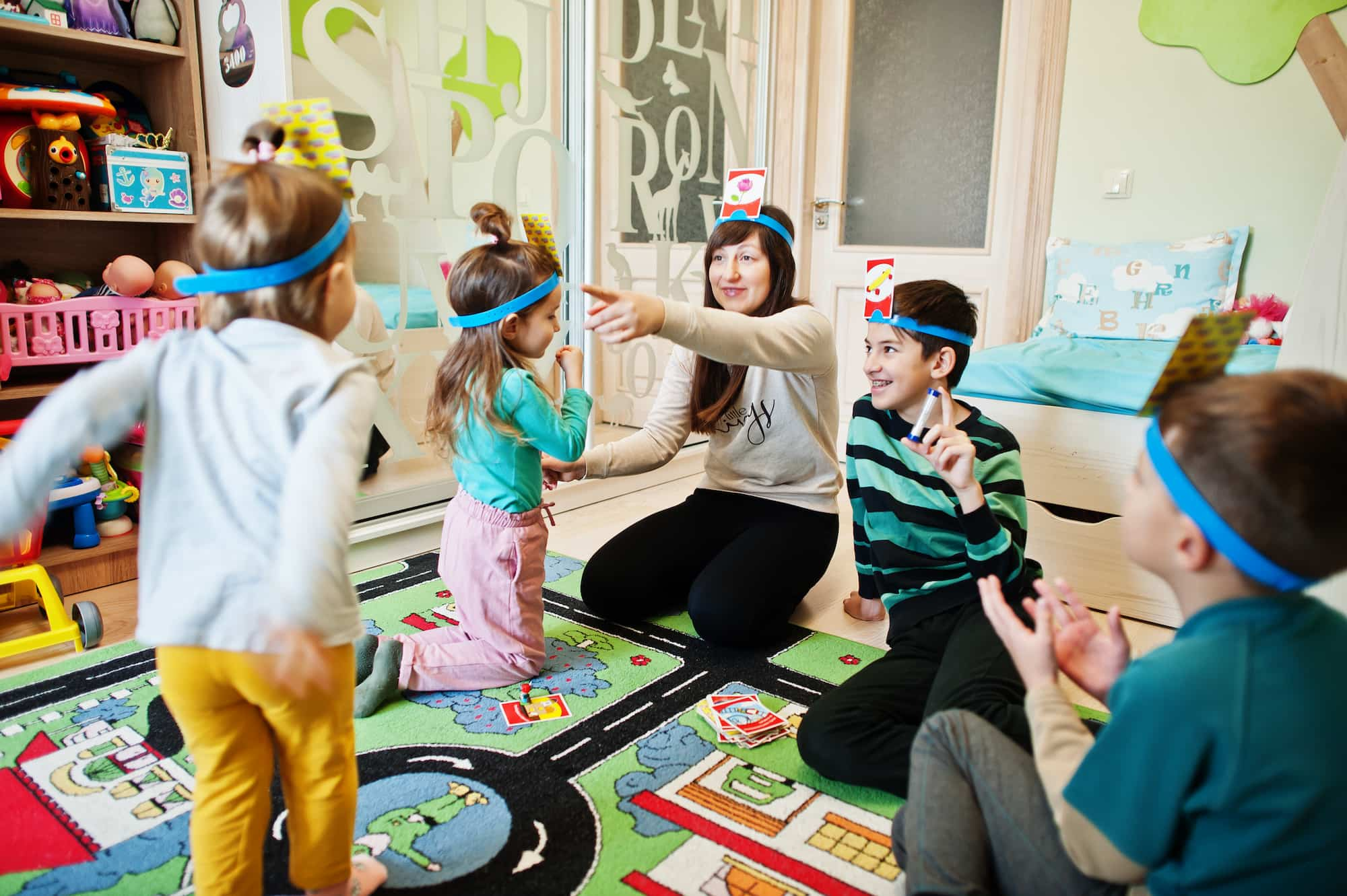
The most useful practice is ordinary group time. Library storytime is ideal, because your child has to sit still, listen to a book someone else chose, and be respectful of the children around them. A regular playdate with one or two other children teaches sharing and turn-taking far better than a lecture about sharing ever will.
Your nanny can also practice the small separations that make the first morning of school easier. A child who has said goodbye to a parent at the door and spent the day happily with their nanny already knows the hardest lesson of kindergarten: Mom and Dad always come back. If goodbyes are still hard, ask your nanny to keep them short, warm, and consistent, the same words, the same hug, every time.
Language and Literacy at Home
Reading aloud is still the single best thing a nanny can do for kindergarten readiness, and it costs nothing. Fifteen minutes a day, with your child on her lap or beside her on the couch, builds vocabulary, attention span, and a love of stories. The trick is to make it interactive. A good nanny points at the words as she reads, asks what your child thinks will happen next, and lets them finish a familiar sentence or rhyme. That is exactly the kind of language play the KRA measures.
Beyond books, the everyday talk matters too. A nanny who narrates the day, “We are putting the red blocks away first, then the blue ones,” is teaching sequencing and vocabulary without a lesson plan. Singing rhyming songs in the car, playing “I Spy” on the drive to the library, and asking open questions at lunch all build the language skills a teacher will notice.
One simple milestone to watch for: can your child recognize their own name in print, and can they write the first letter or two? A nanny can practice this with a name puzzle, a chalkboard, or letters formed out of playdough. Keep it light. If it becomes a chore, your child will resist it, and the goal is confidence, not perfection.
Early Math in Everyday Moments
Kindergarten math is not worksheets. It is counting, sorting, comparing, and recognizing patterns, and a home is full of chances to practice all of it. Your nanny can count the stairs as they walk up, sort the laundry into piles by color, measure flour while baking together, and ask your child to set the table with one fork for each person. Each of these is a real math skill dressed up as a normal day.
Board games are a quiet powerhouse here. A simple game with a spinner or a die teaches counting, taking turns, and handling the disappointment of losing, all at once. Puzzles build spatial thinking. Even a walk through the neighborhood can become a pattern game: red car, blue car, red car, what comes next?
If your child can count to ten, recognize a few numbers, and sort objects by size or color, they are right where they need to be. Your nanny does not need to teach addition. She needs to give your child lots of chances to count real things.
Physical Skills and Self-Care
This is the area parents forget about, and teachers notice first. Kindergarten asks a lot of small hands: holding a pencil correctly, cutting with scissors, zipping a coat, opening a lunchbox, and managing the bathroom alone. A child who can do these things independently starts school confident. A child who cannot spends the first weeks asking for help with everything, which is exhausting for them and for the teacher.
Your nanny can build fine motor skills through play: playdough, bead threading, tearing paper for collages, and using child-safe scissors to cut along a line. She can build gross motor skills at the park or on a nature walk at a Cleveland Metroparks reservation, where climbing, balancing, and running all happen naturally.
Self-care matters just as much as strength. Practice the lunchbox at home before school starts. Can your child open their own containers and unwrap a sandwich? Can they put on their own coat and zip it? A nanny who builds these into the daily routine, letting your child try first before helping, is doing real kindergarten preparation.
Where to Practice in the Cleveland Area
Cleveland families have an unusual advantage: the free programs here are genuinely good, and your nanny can take your child to them during the week.
Cuyahoga County Public Library. CCPL runs Kindergarten Club for children entering kindergarten who did not attend preschool, with hands-on activities and a free book for each family at the end of each session. Its Focus on 4’s and 5’s storytimes, for preschool children ages four and five and their caregivers, build kindergarten skills through stories, songs, and activities, and its Kindergarten Countdown sessions run at branches including Beachwood and Independence. Registration is required, so ask your nanny to check the library’s events page and sign up early, since popular sessions fill up. The Shaker Library, Heights Libraries, and Cleveland Public Library branches run regular preschool storytimes too, and a weekly storytime is the easiest readiness habit to build, because it is free, consistent, and practices sitting, listening, and following a group routine.
Children’s Museum of Cleveland. At 3813 Euclid Avenue, the museum’s hands-on exhibits let preschoolers practice problem-solving, building, and imaginative play, all of which feed directly into the KRA’s four areas. It is a strong rainy-day or cold-weather outing for a nanny and a four-year-old.
What to Do If Your Child Seems Behind
Some children need more time, and that is normal. Development is not a race, and a four-year-old who cannot yet write their name is not behind. But if your nanny notices something that worries you, a child who rarely speaks in full sentences, who cannot follow a one-step direction, or who seems unusually withdrawn around other children, talk to your child’s pediatrician first. Your pediatrician can tell you what is typical for your child’s age and whether an evaluation would help.
Your school district can help too. Ohio requires a screening by November 1 of your child’s first school year, covering vision, hearing, speech and communication, and developmental concerns. If you have questions before school starts, your district’s early childhood office or your child’s preschool teacher are good places to ask.
What you do not need to do is drill your child. Flashcards at the dinner table and workbooks before bed will not make a child more ready, and they can make a child dread school before it starts. Play, talk, read, and let your nanny do what she does best: give your child a safe, steady day full of small chances to grow.
How InHome Care Solutions Helps Cleveland Families
Finding a nanny who can do all of this, someone warm, patient, and genuinely good with a four-year-old, is exactly what InHome Care Solutions does. Founder Mara personally oversees every match, and every caregiver completes a 12-step vetting process that includes identity and background screening, a driving-record review, employment and reference verification, a social-media evaluation, and CPR and first-aid confirmation. Before you commit, a two-day working trial lets you see how a nanny fits into your family’s real routine, and every placement is backed by a 90-day replacement guarantee.
Whether you live in Shaker Heights, Beachwood, Hudson, Chagrin Falls, Parma, Strongsville, Westlake, or anywhere across Northeast Ohio, a personally matched nanny can give your child the steady, playful days that build kindergarten readiness, and give you the peace of mind that comes with knowing your child is in good hands.
Book a free consultation today. Call 440-538-8227, email mkg@inhomecaresolutionsco.com, or visit www.inhomecaresolutionsco.com to start your search.